
Denmark is becoming an increasingly popular tourist destination, and with an interesting variety of galleries and museums to boot, there are plenty of beautiful sights to see.

Amongst its many museums and historical sites, the National Museum of Denmark exhibits artifacts from the Viking Age. One of the most fascinating places to visit in Denmark to learn more about the Viking Age and this historical period, is in the town of Jelling where the famous Jelling Stones are located. These enormous rune stones are believed to date back to the 10th century CE. These stones are located in a churchyard and were originally placed to represent the transformational period between Norse Paganism and the development of Christianization in Denmark.
The smaller stone was first placed by King Gorm The Old, in loving memory of his wife Thyra Dannebod. In later years, his son Harald Bluetooth placed the larger stone in memory of his parents. His placing of the stone was in celebration of his conquest of Norway and Denmark. This stone is viewed as Denmark’s baptismal certificate, with an illustration of Christ on one side and a serpent wrapped around a lion on the other side. It is believed to be an inscription celebrating the conversion of the Danes to Christianity. The stones together are considered a visual record of this transitional period.
Inscriptions on the Jelling Stones
The smaller rune stone raised by King Gorm for his wife, has an inscription that reads: “King Gorm made this monument in memory of Thyra, his wife, Denmark’s adornment.” The larger rune stone, which was placed by King Gorm’s son Harald, reads: “King Harald ordered this monument made in memory of Gorm, his father, and in memory of Thyra, his mother; that Harald who won for himself all of Denmark and Norway and made the Danes Christian.”
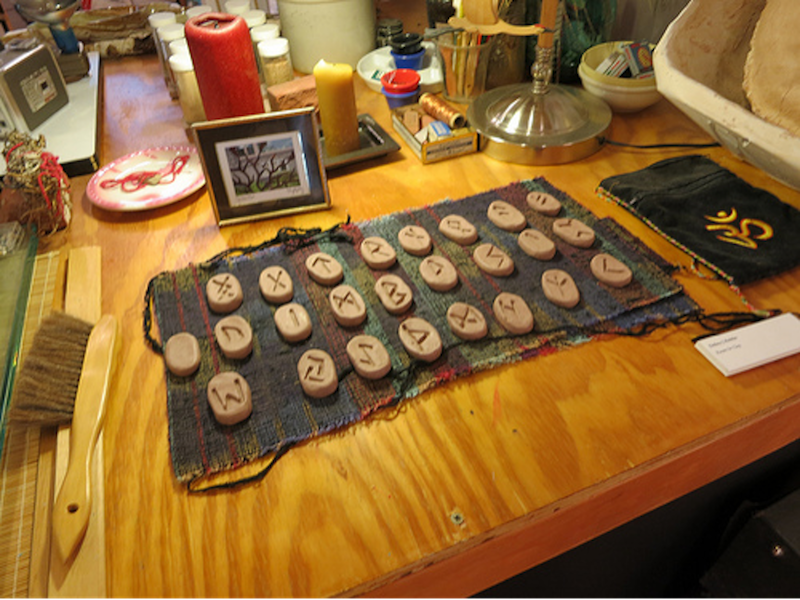 Photo: Runes” (CC BY-SA 2.0) by nullrend
What are Rune Stones?
A rune stone is a stone raised above ground that contains a runic inscription on the face of the stone. The tradition of inscribing stones lasted from the 4th century – 12th century CE, but were mostly present during Viking times and are believed to be memorials to the dead. Legend has it that a Norse warrior called Odin fasted for nine days, hanging from ‘Yggdrasil’ the tree of knowledge, seeking understanding and wisdom of life and death. From his experience came the knowledge and belief in the rune stones, aiding Vikings on their travels, giving them wisdom and understanding for success in their endeavors. In more recent times, runes stones are used as a form of divination, a tool used alongside a psychic gift. Rune stones are cast by the psychic and are said to give more detailed insight, enhancing their natural psychic gift.
Modern Day Rune Stone Meanings
The runic alphabet appear as symbols on the stones, and most commonly the ‘Fulthark’ alphabet is used. During a runes reading, the rune name is given, and then the meaning of the stone and how it relates to the reading is revealed. Below are examples of some of the stones that can appear in a runes reading:
FEHU – Symbolizes abundance, success, hope and happiness.
TIWAZ – Represents justice, leadership, authority, honour and rationality.
LAGUZ – Suggests psychic powers, connection with the universal energy, healing and renewal.
EHWAZ – Symbolizes change for the better, movement, promising future, harmony, teamwork, trust and loyalty.
WUNJO – Signifies prosperity, joy, comfort, harmony and friendship.
INGWAZ – Represents family love, strength, virtues, caring for each other and common sense.
The Jelling Stones can be said to contain a spiritual energy, as both stones were raised by a family of loved ones and continue to stand today, after all these years. Whether you’re travelling up the Danish Riviera or visiting the Viking Ship Museum in Roskilde, no matter where you go you will find Viking history. Denmark has many beautiful destinations and popular attractions and is absolutely well worth a visit!
Article written by ZOE MILLES.
