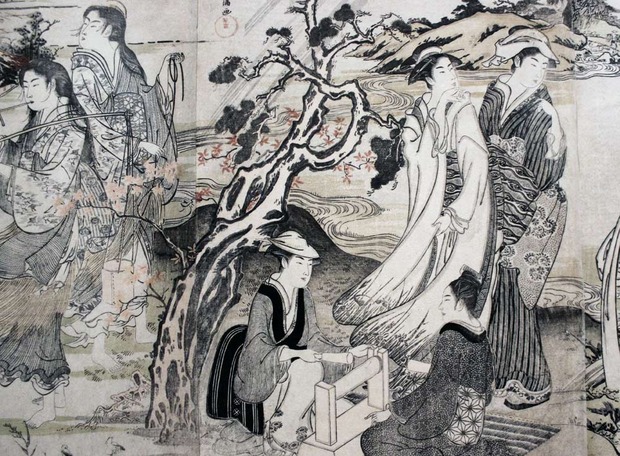
The Edo period (1603-1868) was a time of great peace.
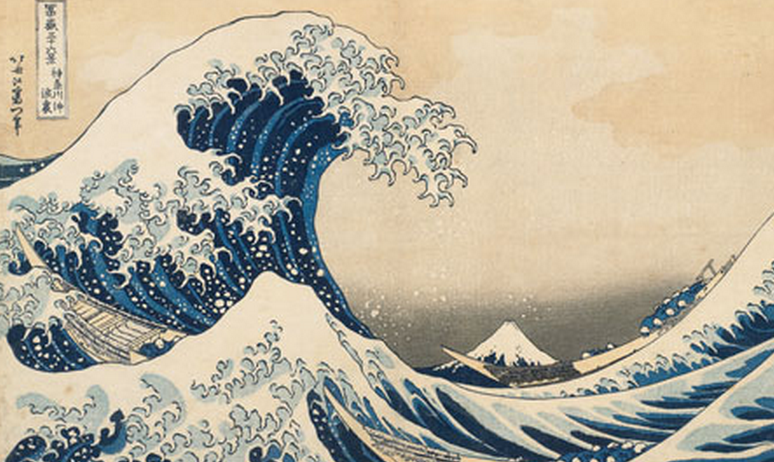
Rich commoners oversaw the development of the arts to suit their popular tastes. These new popular art forms included kabuki theatre and woodblock prints. Edo-period woodblock prints—which often exhibited beautiful courtesans, famous kabuki actors, tourist sites, and fantastical tales—were called ukiyo-e, or “pictures of the floating world.” This term refers to the fleeting beauty and impermanence of the world, especially in the realm of entertainment that was responsible for fostering such evanescent moments. However, this theme of transience harkens back to ancient times.
The Japan Society’s current exhibit, Edo Pop: The Graphic Impact of Japanese Prints (March 9-June 9, 2013), highlights the effects of ukiyo-e prints on contemporary artworks by Paul Binnie, Lady Aiko, Emily Allchurch, Masami Teraoka, Ishii Toru, Narahashi Asako, and others. The exhibit is organized by theme: pictures of beautiful people, kabuki actors, landscapes, and the “joy of life.” Each room juxtaposes contemporary artworks with the Edo-period woodblock prints that either inspired them or share similar techniques and themes. By tracing these influences, Edo Pop offers the public a fundamental exercise in art history.
 While I am usually intimidated by the often alienating, sterile aesthetics of contemporary work, I was delighted to find that the contemporary art on display at Edo Pop was just as flirty, frivolous, clever, and colorful as their Edo-period counterparts. Ukiyo-e prints are often embedded with visual allusions to past historical events and literary works to humorous effect; this practice is called mitate. For instance, an Edo-period artist might have depicted a lowly pimp and his prostitute enacting the celebrated courtly rendezvous of Prince Genji and one of his ladyloves. Thus, I enjoyed the playful irony of Paul Binnie’s works, such as the series “A Hundred Shades of Ink of Edo” (2011), which portrays male bodies covered in tattoos derived from famous ukiyo-e works. He enacts the visual games of mitate in a modern way, highlighting the sexualities of the Edo-period “beautiful people.” Another of my favorites was a piece by Ishii Toru entitled Tokyo Tower (2007). Depicting a mountain composed of stressed-out salarymen, the work is based on Katsushika Hokusai’s famous series, “Thirty-six Views of Mount Fuji” (1831-1834). What makes the piece most interesting is that Toru uses traditional textile-dying techniques that were developed simultaneously with those of Edo-period woodblock printing.
In their time, ukiyo-e prints mingled the characteristics of high and low art, and these tensions are mirrored in Edo Pop’s contemporary works, for they often straddle the boundary between fine art and decoration. These works exude a sense of desperation in preserving the floating world before its disappearance, so that we may forever yearn for it. Sure enough, we will never see such kimono-clad beauties again, but Edo Pop’s contemporary works seek to create a new “floating world” for modernity’s sake.