
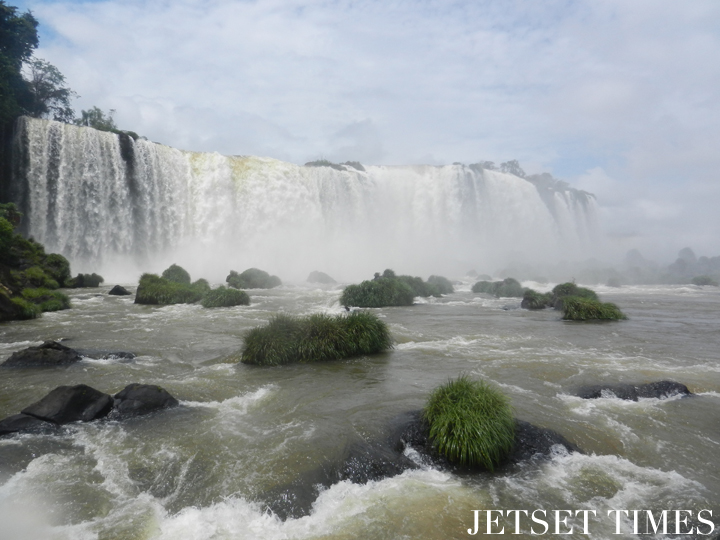
Take a look at our photo gallery below to see what makes Iguaçu Falls one of the world’s greatest natural wonders!
 Flickr/Jerry Leon
Nestled within the tri-border region of three South American countries (Argentina, Brazil and Paraguay) is located one of the world’s greatest waterfalls and incomparable natural wonders: Iguaçu Falls. Inscribed as a UNESCO World Heritage Site in 1986, Iguaçu National Park receives just fewer than 750,000 visitors a year.
Founded on January 10, 1939, Iguaçu National Park (whose name derives from the Guaraní word for ‘Great water’) shares a portion of the waterfalls with neighboring Argentina (Iguazú National Park). At over 2,700 meters (almost 8,860 feet or 3 kilometers) in diameter and 80 meters (more than 260 feet) in height, the combined force of Iguaçu’s 275 separate waterfalls is enough to produce the world’s sixth largest average annual flow of water (1,746 m3/s or 61,660 cu. ft./s). The consequential output generated by Iguaçu Falls means the surrounding area is blanketed in a permanent mist, conveniently aiding the verdant growth of endemic plant and tree species (2,000 and 80, respectively), as well as providing a home to 400 species of bird.
As the larger of the two national parks (170,000 hectares compared to Argentina’s 55,000 hectares), both parks jointly make up the largest remnant of the once prominent Atlantic Forest (estimated to have covered an area of 1 to 1.5 million square kilometers or 390,000 to 580,000 square miles) when the first Portuguese explorers arrived more than 500 years ago.
Travelers often ask which side offers the best and, therefore, most worthwhile views of the waterfalls. It’s a difficult question to answer since both sides have their unique appeals, but one of the distinguishing features of Iguaçu Falls that sets it apart from its sister park are the spectacular views from inside and above the Garganta do Diabo (Devil’s Throat). The power and force exerted by Salto Floriano (the waterfall directly in front of Garganta do Diabo), especially given its close proximity, makes for a thundering (it does get quite loud) and unforgettable experience that makes the Brazilian side well worth a stop.
So, if you’re planning a visit to the region and are perhaps undecided as to which side is better, take a look at our photo gallery below to see what makes Iguaçu Falls one of the world’s greatest natural wonders!
START SLIDESHOW:


