
How Noma continues to create food for the future.
 Zucchini Stem and Sunflower Seeds (with crickets.) PHOTO WENDY HUNG
For the last ten years, I’ve spent many hours in the kitchen with incredible chefs. Some of my first interviews were with culinary greats: Albert Adrià of Enigma (Barcelona, Spain) Corey Lee of Benu (San Francisco, Ca.,) Matt Orlando of Amass (Copenhagen, Denmark) which has since closed its doors. When Matt and I sat down next to his garden and chatted for an entire afternoon, I couldn’t help but inquire about his experiences working at Noma. After all, what René Redzepi has built since 2003 has now become a myth. An outright legend.
View this post on Instagram
Notorious for coveted reservations that require years of unwavering patience, getting to devour a sumptuous meal at the three Michelin-starred restaurant is akin to winning the lottery. Last month, I somehow found myself sinking into full-body chills inside the fable. Thanks to a friend’s generous invitation, I was sipping from a glass of A Hum Pinot Blanc by Eishi & Mayuko Okamoto – one of a series of 300 natural bottles made in the Yamanashi prefecture of Japan. The elegant wine poured in the shade of faded orange peel; fumed in pomelo, jasmine, dried mango and Sri Lankan green tea. Japanese art is rooted in balance and harmony, somehow it all blended seamlessly with the view of Noma’s famous garden accenting Scandinavian flora and halcyon beehives.
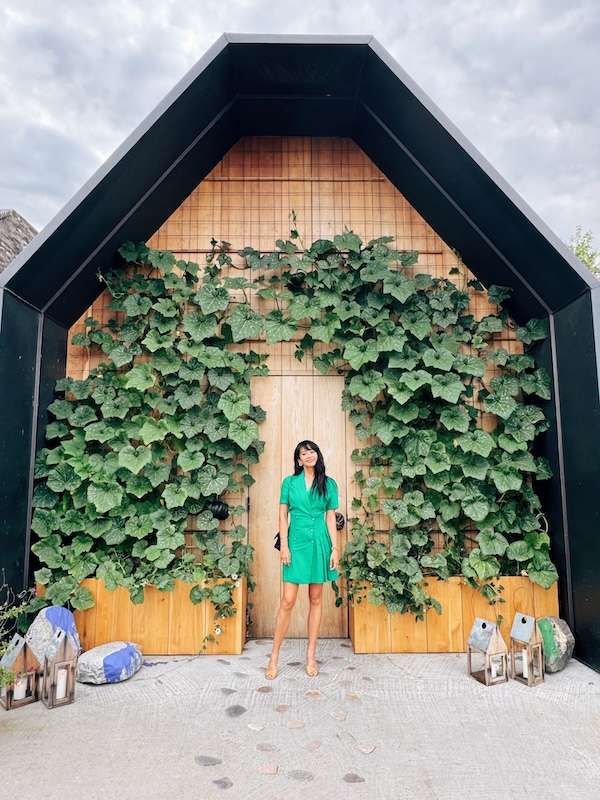 Noma’s famous door.
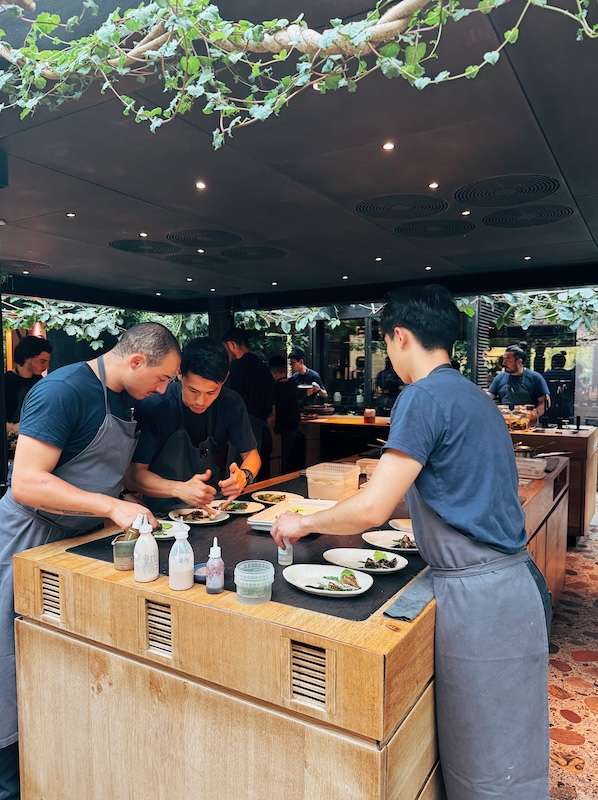 Chefs in open kitchen. PHOTO WENDY HUNG
The Noma experience begins with a stroll down its garden which acts as a buffer zone between diners and onlookers. Upon greetings from violet artichoke flowers, we came to face the restaurant’s iconic wooden doors. Just as many have recounted in their own Noma storybooks, groups of chefs left their stations to shout and greet each arriving diner with cheerful welcome. Young, energetic. They wore smiles as prideful as the blue apron medaled upon their zestful chests.
To be expected, a meal at Noma comes with a massive price tag at around 600 euros/person, in addition to wine pairing at 300 euros/person. The menus are delegated in three parts: Ocean during winter months, Vegetable menu during spring and summer. Then, Game & Forest in the autumn.
 Wine pairing. PHOTO WENDY HUNG
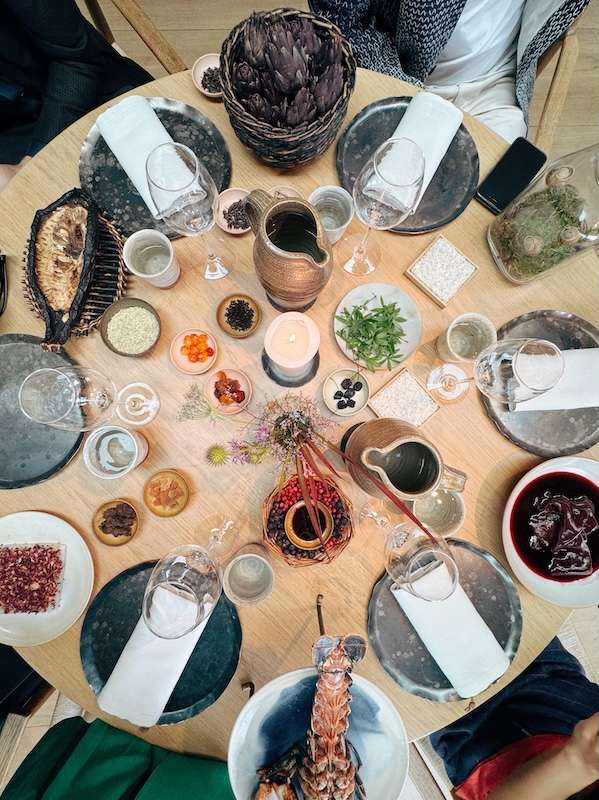 Opening display of everything served during the meal. PHOTO WENDY HUNG
The 15-course meal commenced with a bang. A lemon thyme plant served for each guest, our job was to look for a straw hidden inside the pot to taste the New Potato Soup. It was everything that one would expect from Noma, a dish which stirred all five senses. My eyes were impressed by the visual, nose scented from sweet citrus aroma, our fingers brushed against the foliage in search of a straw as sounds of leaves sang to our ears. All the while, the creamy texture of a cozy soup delightfully juxtaposed summer flair of the shrubby herb. Not all 15 dishes lived up to the marvelous start, but this was a star hard to follow.
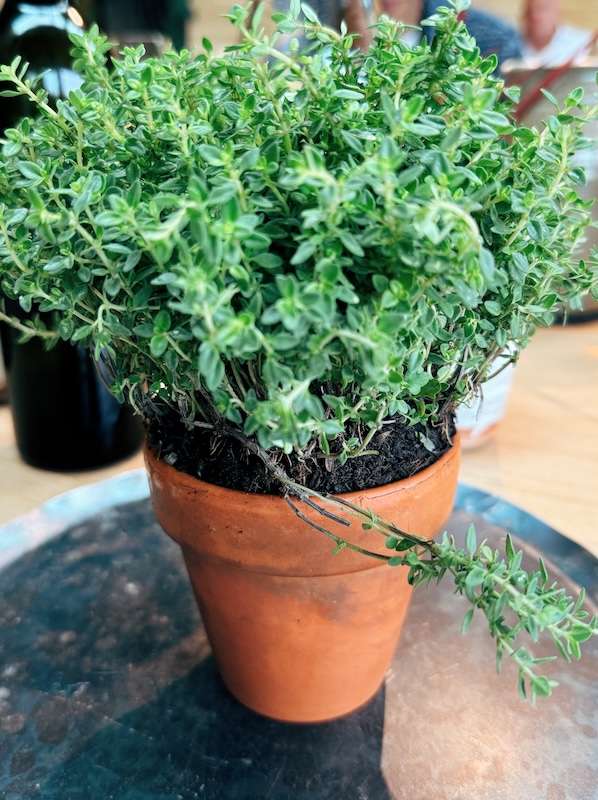 New Potato Soup. PHOTO WENDY HUNG
 Today’s Crudité. PHOTO WENDY HUNG
More than twenty years ago, Noma revolutionized the culinary world, pioneering New Nordic Cuisine. A movement that cherishes purity, freshness and simplicity while paying homage to the Nordic terroir. Sustainability, locally-sourced and nature-based approach continues to live in the heart of the Manifesto which now has transpired into other kitchens around the globe. This was utmost evident in the colorful Flower Salad, Seaweed and Oyster Leaves, and juicy Peas that has even made a cameo in the popular TV series, The Bear.
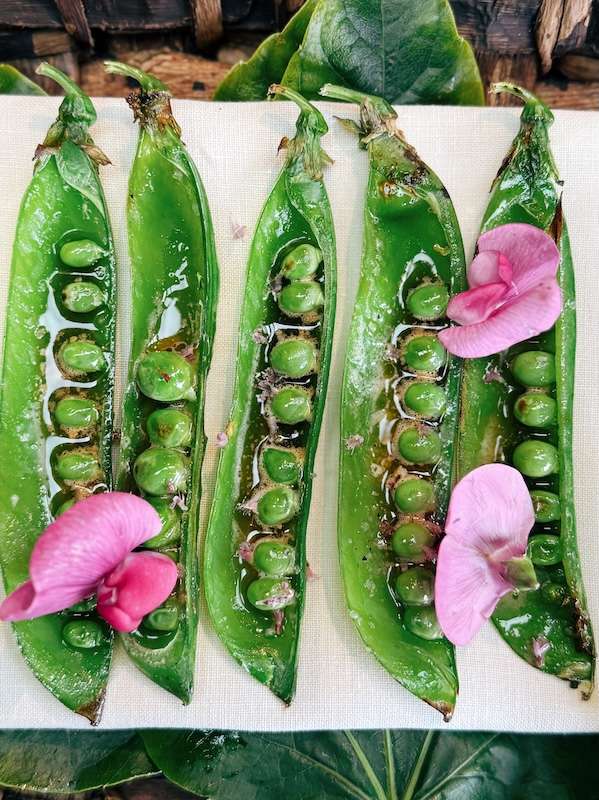 Peas. PHOTO WENDY HUNG
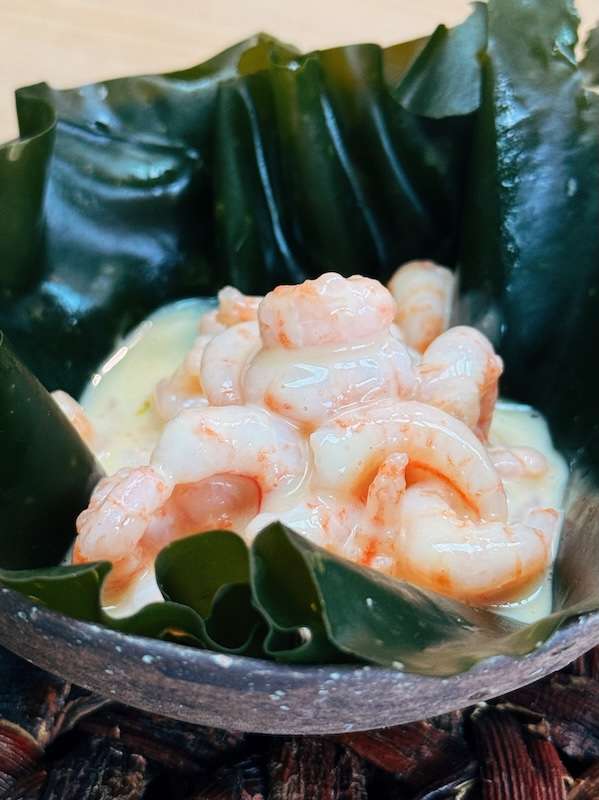 Shrimp Cocktail. PHOTO WENDY HUNG
There’s always a narrative that threads a Noma menu, in this case, the Danish beach rose made several appearances within the plot. During the 1950s, Rosa Rugosa was brought to Denmark from Japan, then planted along Danish coastlines as windbreakers. Today, Noma Project’s Wild Rose Vinegar is a top-seller, while pink petals accompanied several dishes, including: Danish Squid and Roses, and Lobster Feast where the marriage of meat and rose water conveyed gentle fragrance, like an ethereal l’eau de parfum.
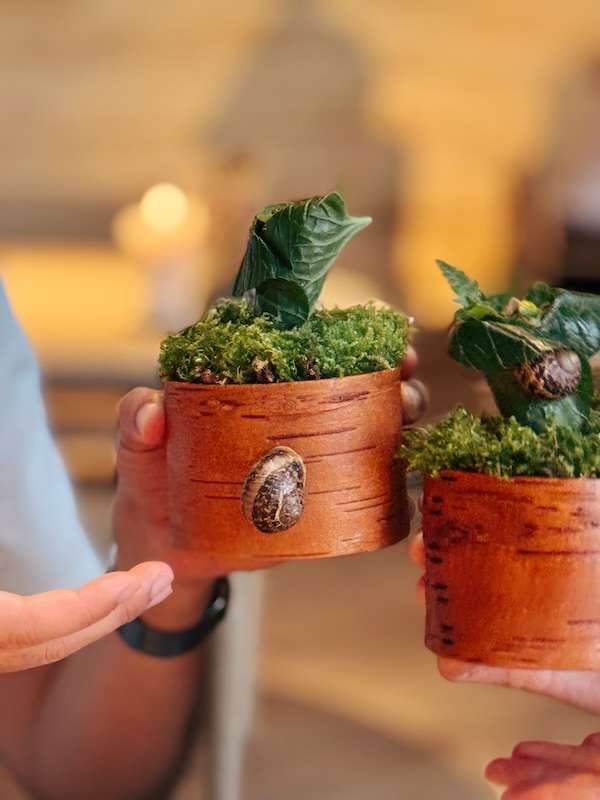 Wasabi and Snail. PHOTO WENDY HUNG
 Flower Salad. PHOTO WENDY HUNG
The Danish beach rose’s origin seeded an effortless Danish-Japanese fusion from start to end, food to drinks. In addition to the wine pairing opener (mentioned above,) the 2023 Minzoku no Sake by Tomonari Miwa from Japan’s Tottori prefecture was a series uniquely produced for Noma, also in limited bottles that, apparently, staff and chefs are fighting over the last bottle.
 2023 Minzoku no Sake – Tomonari Miwa. PHOTO WENDY HUNG
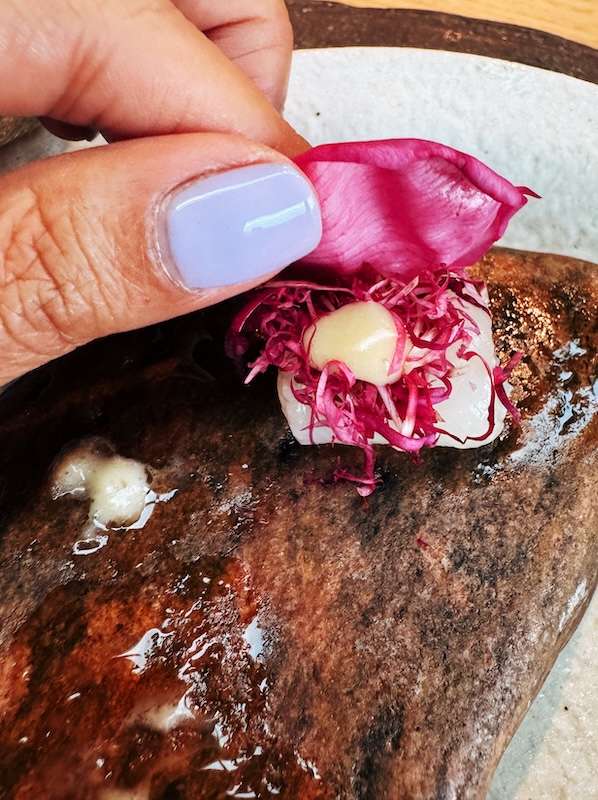 Inside the Danish Squid and Roses. PHOTO WENDY HUNG
The future of food wouldn’t exist without the art of innovation, thus only Noma encourages the audacity to serve SCOBY (Symbiotic Culture of Bacteria and Yeast) to diners traveling from all over the world. The key ingredient to ferment and produce kombucha was served upon plates that resembled a cherry blossom branch – a further nod to Japan. For beet lovers, SCOBY might just become a newfound love.
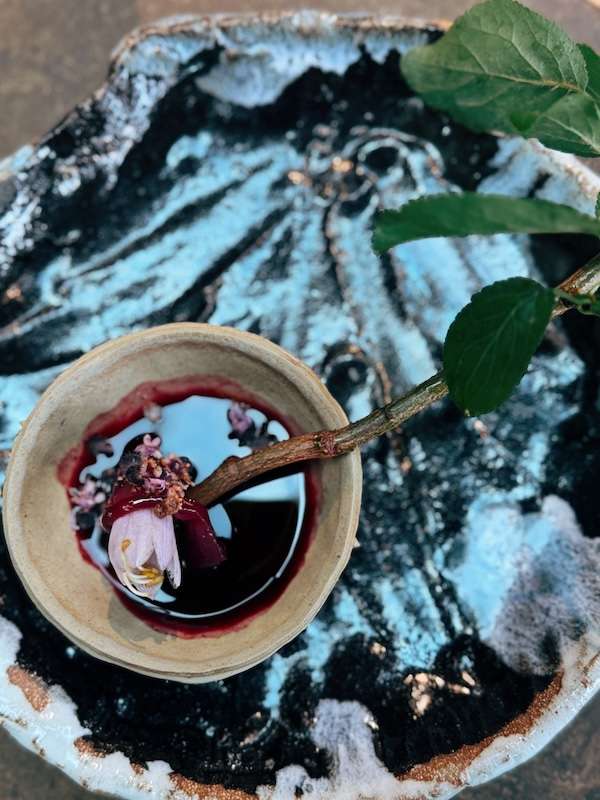 SCOBY. PHOTO WENDY HUNG
 Lobster Feast. PHOTO WENDY HUNG
The meal ended with three desserts, Walnuts and Chanterelles was a personal favorite. Never could have imagined that mushroom or fungi ice cream could taste deliciously nutty and ultra creamy. In the end, we devoured an edible burning candle before making a wish, one that certainly came true on this night.
 Mackerel Wrapped in Magnolia. PHOTO WENDY HUNG
 Grilled Artichoke with Wild Herbs. PHOTO WENDY HUNG
As more boldly high-level restaurants have taken over the spotlight in the last few years, foodies have loved to write about their disappointments in their own Noma experiences. When I deconstruct dishes, there’s a tendency to focus on: geography, philosophy, history and democracy.
Towards the end of the night, in a quiet solo moment stilled by dimmed lights between Noma’s garden and its quieting kitchen, I pinched myself several times. Thankful for a religious experience, as my mind trailed off to those hardworking chefs in all types of kitchens around the world, some working minimum wages only to dream of eating at Noma someday. In the name of democracy, is Noma’s inaccessibility justifiable?
 Noma at night. PHOTO WENDY HUNG
 Berries and Woodruff. PHOTO WENDY HUNG
Since my interview with Matt many years ago, I’ve spoken to more chefs who have also been trained at Noma and have since launched their own brilliant Michelin-starred restaurants. Noma has become a stamp of excellence on a chef’s resumé. The expectations of indulging in these establishments have become nothing short of beautiful surprises, and most importantly, a profound respect for each land’s bountiful resources combined with innovative, scientific techniques.
It goes to show the path that Noma has paved for a new generation of culinary greats. All striving to create food for the future, accompanied by an ode to our lush Mother Earth.
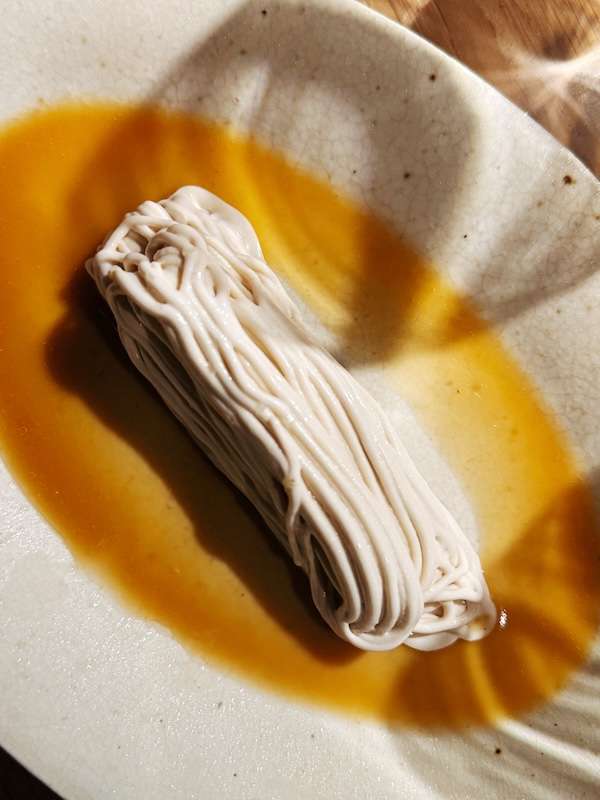 Walnuts and Chanterelles. PHOTO WENDY HUNG
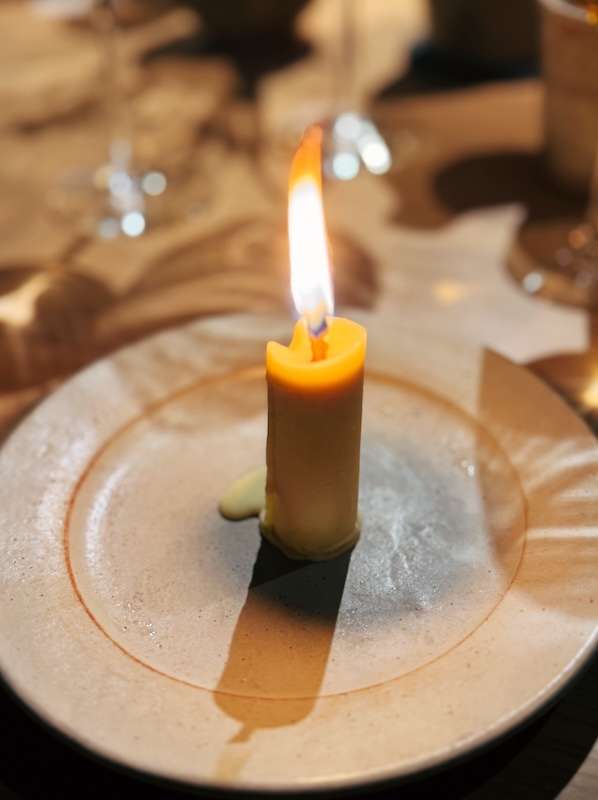 Candle. PHOTO WENDY HUNG