Does our taste in music mean anything?
“I was so intimidated by you when we first met.” These were the recent words by a best friend that I’ve now known for two years. I was thrown back by fear and self-doubt, and I itched to interrogate. “What do you mean? How did I intimidate you? What did I do?” She was laughing. “You said you were into classical music,” she said. “That was so intimidating. You were too cool for me!”
Out of all the things that she could have said — that I had a resting b-face, a condescending voice — she said the one thing I never expected to hear. It is true that I adored certain pieces that would go under the category of classical music, and that I mentioned how I wished to pick up the violin after two decades of piano. But never once did I wonder what people thought of this. How many potential friends have I scared away in the past by one trivial mention of, “Oh yeah, by the way, I listen to Chopin?”
Strange, how we assume musical taste to be a simple, personal matter. We think we don’t judge people on such “shallow” things like musical taste, that we think we are better at looking past taste and into the real, complex person. In reality, musical taste isn’t just personal. If your taste mattered only to you and not to anyone else, why do we feel so attacked when someone doesn’t share our taste? For some reason, “Ugh, you like Justin Bieber?” feels more offensive than “Ugh, you like blue shoes?”
Music is inherently emotional; it’s a communication between the musician and the listener. When someone tells you they don’t like the music you like, there’s a raw, ugly feeling of not being understood on an emotional level – simply speaking, not being able to vibe.

Beyond just its aesthetics, music has been riddled with social meaning over the centuries. The type of music, the artists, and the composers that you like are all manifested with signs of social class, status, political opinion, and even your personality. Whether we like it or not, heavy metal is associated with angsty white men, K-POP fans are seen as “girls who chase after foreign feminine men who all look the same and wear makeup,” and classical music is seen as conservative, elitist, and aloof from the modern music scene.
What’s to note here is that nothing about these stereotypes inform anything about the music’s actual content. Forget how literally cool an electric guitar sounds, or how catchy is the beat. If you like heavy metal, it’s not because you like the freaking guitar — it’s because you are a cynic, a manifestation of toxic masculinity and a hidden violent personality itching to overthrow the world with said violence, alright?
But you can see the truth if you enjoy any type of music at all. Imagine that you are suddenly transported to Mars, and Martians, as it turns out, have no idea about music on Earth and in fact don’t have ears. Would you then destroy your Spotify playlist since it is of no use to you, now that it wouldn’t showcase how much of a rebel you are and how you much hate capitalism? No, you’d still pull it out and listen to it. You like it, and that’s what you do with the music that you like.
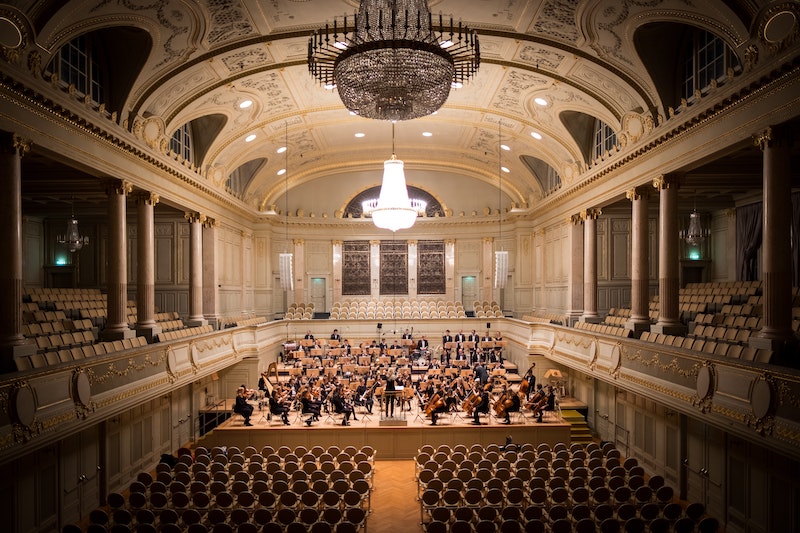
The term classical music often refers to European classical music, composed between the 17th to early 20th centuries. Julian Johnson, author of Who Needs Classical Music?: Cultural Choice and Musical Value, argues that classical music, among other forms of art, is a “reaction against the devaluation of the individual.” In the midst of an increasingly relativist market society where value is becoming more and more subjective, classical music stays true to objective beauty:
“ redeems not just things but also people, whom society increasingly turns into things.” – Julian Johnson
Philosophers Theodor Adorno and Max Horkheimer of the Frankfurt School argue along similar lines, “the notion that art can rebel against social structures” has been destroyed by modern consumerism; that people now believe art can never convey truth, but only ever be an expression of individual and subjective taste.
All of this sounds properly philosophical, but defining art in this way makes most things that we collectively consider as “art” not art at all. Of course, pop music is out of the question, and the philosophers above would agree: the value of a pop album is defined by how well they sell, not by any metric independent of societal forces. Troublingly, however, this turns out to be the same case with what we consider “classic art” as well.
Brandt Dainow, a lecturer of philosophy at the National University of Ireland, argues that the image of the “real artist” as a signaler of absolute aesthetic and political truth, who perpetually pushes against the forces of society, is a complete myth. Mozart’s music was just as commercial as Justin Bieber — his popular opera The Magic Flute was written for and first performed in the Viennese Theater auf den Wieden, “a popular, commercially-oriented” venue, “not as elite art, but as popular entertainment for the masses.” Shakespeare’s theaters were structured in such a way that the lower-class “groundlings” paid the least and sat on the floor, and the upper-class paid triple that to sit at the tables in the higher galleries, having the best view. While Mozart and Shakespeare are both treasured to this day for their artistic genius, it’s simply mistaken to assume that their artwork was reactionary and their value defined outside of subjective perception.

This is also true for composers and artists that received commissions from the upper-class and the aristocracy: the Mona Lisa was commissioned by a Florentine nobleman, The Nutcracker ballet was commissioned by the Imperial Theaters, which was run by the Russian Empire. The bulk of classic art never went against power. Rather, the context in which and for which such art was produced was power itself.
A major misconception of classical music perpetuated by those who study it, is that classical music can only be “understood” by the proper and the educated. The value of classical music and other classical art forms were more defined by pure market forces (the public) than by some absolute standard of beauty or truth, only perceptible to educated intellectuals. Classical music isn’t more difficult than pop music by any objective measure. What you find enjoyable depends on what music you have been listening to all along, not how “educated” you are.
It makes sense to look at musical taste as language. No one can tell if Japanese is harder or easier than English. Knowing Japanese only means that you were brought up in Japan or you chose to take Japanese in school, not that you are smarter than someone who speaks English.
And finally, all this speaks to our tendency to romanticize what we don’t have — including history. We have a romanticized vision of Mozart, Shakespeare, and their audiences at the time, as if they were somehow more sophisticated than we are now. As if society has only degraded since then, eaten alive by industrialization and consumerism. While we have our problems, there’s simply no historical basis to assume that someone who enjoyed Mozart’s Magic Flute back in the day was intellectually much different from you, who enjoy BTS. Just remember this the next time someone tells you they enjoy classical music. They just like it.