
Find out why “Unfinished: Thoughts Left Visible” is a thought-provoking, intellectual masterpiece.
As I planned my fall day trips and explorations, I was eager to spend an endless afternoon at the Met Breuer in New York City, visiting the exhibit Unfinished: Thoughts Left Visible. Over the summer, I quickly stopped by the museum and was caught completely off guard by the thought-provoking beauty of this intellectual masterpiece. Much to my dismay though, I learned that the exhibit closes during Labor Day Weekend. So, since most of you reading this cannot experience the magic of Unfinished in person, this is the best we can do for now.
Let me just preface my analysis by saying outright: I have been to several museums. And, by several I mean an inordinate amount of museums. I thrive off of them. They provide intellectual stimulation away from a school setting and open doors to suffering, hope, love – the greatest of all human emotions and the richest of all movements, minds, and time periods. As many museums as I have been to, and as many exhibitions as I have seen, this one, Unfinished was by far and away, my most inspiring…at least in relation to my craft.
Unfinished draws from 197 works beginning in the Renaissance and leading up to contemporary works of today. It features incredible, well-known geniuses like Picasso, Dalí, El Greco, and Titian just to name a few. The exhibit highlights works that were unfinished for numerous reasons. Some were simply deemed unfit by the artist and discarded, others were interrupted by other projects or life circumstances. Some were even left incomplete when the death of the artist froze them in time forever. As an artist though, the most striking aspect for me was staring at rooms completely filled with unfulfilled potential. I spent my time meandering while looking at paintings and thinking: If this were completed, the world would have one more Picasso or He was so close! Why did he stop? Hauntingly, this exhibit wreaks of the words “what if” and causes the viewer to deliberately contemplate the “what ifs” in their own life – the unfinished manuscripts, relationships left without closure, and opportunities only half begun.
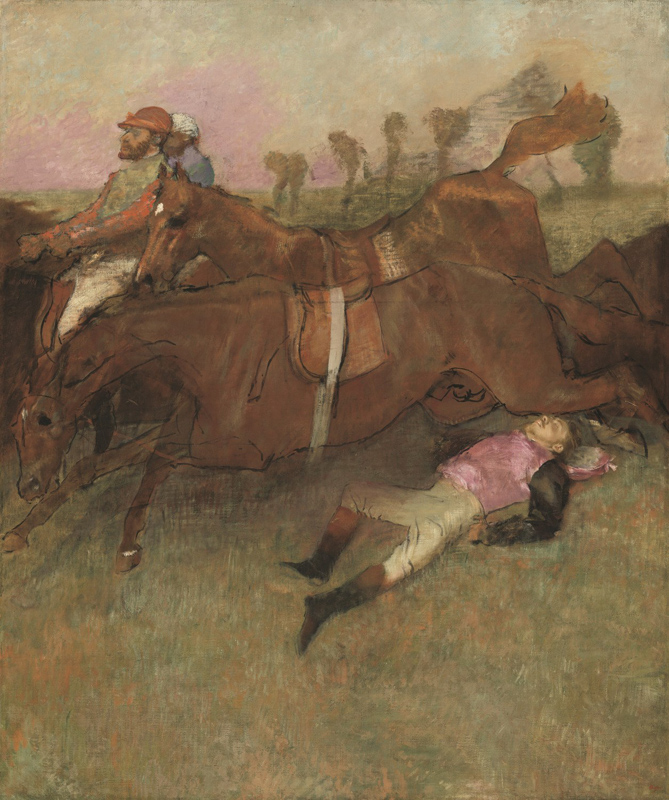 Edgar Degas (French, 1834–1917) | Scene from the Steeplechase: The Fallen Jockey | 1866, reworked 1880–81 and ca. 1897 | National Gallery of Art, Washington D.C. Photo: Facebook/The Metropolitan Museum of Art, New York
The exhibit is meant to ask the question of termination: How do we know when a work is complete? But, for me, it provoked questions of indeterminate lengths. What do we have to do to ensure that a work does get done? Much to my dismay, the exhibit closed during Labor Day Weekend. For readers living in New York, get out of your apartment and hustle down to central park! And for those who just simply can’t miss out, check out the exhibit on the Met website and consider ordering the detailed book which reveals the works as they were collected.
