Are Israel’s efforts to restricting the access to water in Palestinian territories a necessary measure for Israeli national security, or is it just a violation of international law and human rights?
(For a more detailed analysis on the Israeli-Palestinian Conflict along with key terms and historical references please refer to my two previous articles “Israeli-Palestinian Conflict: A Comprehensive Guide, Parts I and Part II)
Water is one of the world’s most important resources, as it is essential for any life and the advancement of any civilization. The water crisis in the Middle East, however, is deeply rooted and has become highly politicized.
Israel and Palestinian territories are in a serious water crisis. Not only is access to water for Palestinians restricted, but there is a concerning water deficit in the region, which threatens the capacity for human life.
Israel’s efforts to restrict access to water in occupied Palestine have been said to be a necessary measure for Israel’s national security, but is it just a violation of human rights and international law?
Background Information
Geographic Context
There are three main water sources in Israel and occupied Palestinian territory: the Jordan River Basin, the Coastal Aquifer, and the Mountain Aquifer. Israel controls the greater part of the Jordan River Basin and the West Bank Aquifers, and through the occupation of the West Bank, Israel controls both the westward-flowing aquifers and all waters which flow into the Jordan River.
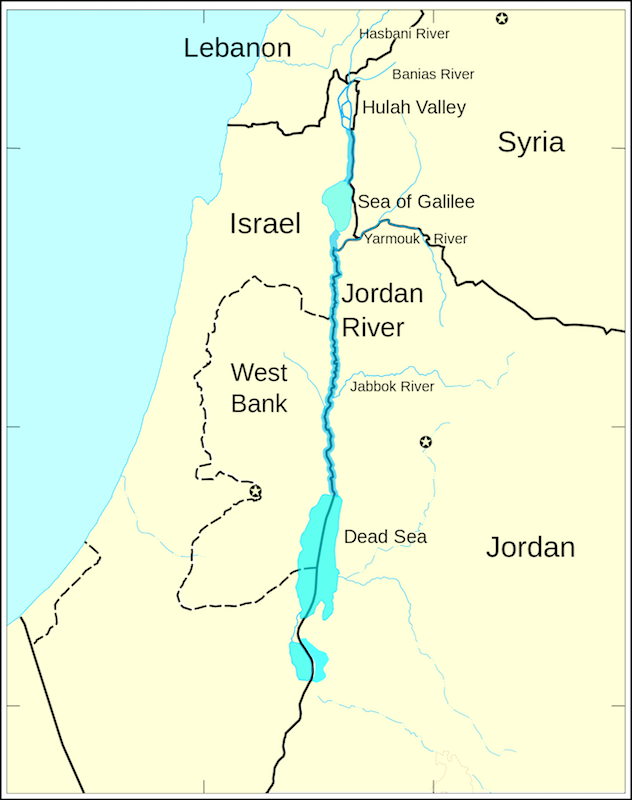
Today, Israel draws an annual 70-100 million cubic meters (mcm) from the Yarmouk River and pipes 1.5 mcm from Lake Tiberias. The Jordan River, which once had an average annual flow of 1250 mcm, now records only 152-200 mcm. To a significant extent, Israel relies on resources extracted from Palestinian territories – the majority of which come from underground water resources, which are crucial for this region as surface water constitutes less than half of the total supply.
Although located in Palestine, Palestinians are prevented from utilizing the West Bank’s underground water, and permits must be obtained from military authority for Palestinian well-drilling. This is an arduous process, it is estimated that only 20 permits have been granted since 1967.
Roughly 25% of West Bank households do not have access to piped water, so residents are dependent on the Mountain Aquifer. The Palestinian Authority, however, does not desalinate or treat water for agricultural use, which is an important part of the Palestinian economy and way of life.
The Gaza Strip has no substantial surface water, so residents rely on water accessed from the Coastal Aquifer. Both the European Union and UNICEF estimate that 90-95% of water in the Gaza Strip is not potable; in 2014, the Human Rights Committee raised concerns about this situation as only 5-6% of residents consider their water to be safe enough to drink.
Historical Context
Before 1967 Palestinians accessed and managed water distribution from local wells and springs. Israel established a national water company, Mekorot, which distributes water for industrial, agricultural, and domestic consumption. Soon after Israel’s occupation of the West Bank, East Jerusalem, and the Gaza Strip in June of 1967; Israeli military authorities consolidated power over all water resources and water-related infrastructures in these regions.
Following the Six-Day War, Israel assumed control over the largest part of the water in the West Bank, and Israeli authorities began to enforce restrictions on the drilling of wells. The Israeli military authority applied an extraction quota that capped the total quantity of water that Palestinians could withdraw, but as the population began to increase, this extraction quota remained the same, adding to water disparities.
Efforts toward peace negotiations have been in discussion since 1991. On the bilateral level, the 1993 Oslo Accords discussed water resources and the need for research on desalination infrastructures. The Gaza and Jericho First Agreement, (known as the Cairo Agreement,) signed in 1994, provided the Palestinian Authority with more leadership in the water supply system in the Gaza Strip. The 1995 Oslo Interim Accord (known commonly as Oslo II,) signed between the Palestinian Liberation Organization (PLO) and Israel, discussed the water issue in depth. In Article 40, “Water and Sewerage” Israel recognized Palestinian water rights in the West Bank, and the Palestinian party was given the right to extract 20% of the annual renewable volume of the Mountain Aquifer and the Coastal Aquifer according to its needs. The Joint Water Committee (JWC) was created to regulate and ensure the implementation of these rules, but although these negotiations were meant to regulate matters for an interim period of five years, the parties did not reach a final agreement.
These talks were successful, however, in the sense that they initiated international foreign aid for Gaza and the West Bank, as 29 states and organizations pledged over $300 million for water projects. Israel’s blockade of the Gaza Strip in 2007, however, resulted in a shortage of electricity and fuel which halted treatment projects, furthering the contamination of water in aquifers.
This issue continued from 2010 to 2014 as the conflict between Israel and Hamas and the Israel Barrier built in the West Bank had similar consequences. The International Court of Justice (ICJ) has expressed serious concerns regarding the access to water for residents in Gaza, and especially for Palestinians living near the West Bank wall.
Israeli and Palestinian Perspectives
Israeli Perspective
National security is one of the central concerns in Israel’s dialogue surrounding the water crisis. It is this concern that influences many of Israel’s approaches toward solving the problem. Before the establishment of the state of Israel, water scarcity was seen as a limiting factor in state-building. With this as its foundation, Jewish Agency sought investments from early on to be made in the water industry. After Israeli state sovereignty in 1948, Israel further pursued policies of the control of natural water supplies and resources to boost economic development and advance state-building.
The natural water resources in this region, however, were exploited and utilized prior to 1948, and by 1967, water became completely privatized in order to meet the needs of the increasing Jewish population. Water dependency has always played an important part in Israel’s national security agenda. Many have argued that this has led to Israel not seeing the problem through a humanitarian lens.
Palestinian Perspective
Palestinians view this issue as a violation of human rights, and although laws themselves do not explicitly violate any human rights, in practice, they have restricted water supply to the point where the average Palestinian in an occupied territory is receiving 15 liters of water less than the World Health Organization’s recommended minimum of 100 liters. According to international experts, the basic essentials for public health include proper housing, adequate nutrition, and a clean and sufficient water supply.
Beyond that, the Palestinian economy has been heavily impacted by Israel’s water policies. Palestinian businesses are forced to rotate their access to water on a continuous basis, and this unpredictability has led to a less than favorable risk-reward environment for potential investors.
The United Nations International Law Commission and the non-governmental International Law Association have formulated a recognizable and established body of international water law, which addresses water rights to various sources. The international recognition of the inherent rights of water, and extended human rights theories are also increasing. The World Health Organization (WHO) similarly published a report on the right to water as a basic human right. Moreover, in the last fifty years, international conventions, customs, and decisions have addressed this fundamental right to water and have provided support for Palestine’s claim to water rights.