How one Egyptian pharaoh has produced a million stories.
 Egyptian Relief of Two of Akhenaten’s Daughters, c. 1353-1336 BC, from Hermopolis in the Metropolitan Museum of Art. FACEBOOK Digital Maps of the Ancient World
Egypt is home to some of the world’s greatest tourist icons—pyramids, sphinxes, mummies, hieroglyphs…Entire movies, pop songs, video games, and theme parks have been designed after Ancient Egypt, or at least the Egypt as we know it. Even so, one of Egypt’s most legendary historic figure is Akhenaten, a pharaoh who ruled in the 1300s BC and the father of the famed Tutankhamen. A religious leader and an artistic pioneer, a captivating mix between powerful and evil, the worldwide fascination with him has blown up to the extent that he has even been given the title of “history’s first individual.”
Akhenaten ruled during the eighteenth dynasty of Ancient Egypt, dating from 1550 to 1292 BC, a period of particular military and diplomatic strength. The empire continuously expanded and the workforce bloomed, with much of the extra booty being poured into shrines and temple communities for Egypt’s many gods.
Akhenaten this flourishing culture around him and tore it from the roots. Swapping out his people’s centuries-old polytheistic system, he introduced a far more centralized belief system that revolved around just one divinity: the Sun. Originally named Amenhotep III, Akhenaten had changed his name during his reign to better fit the role he bestowed upon himself: Akhenaten meant “beneficial to the sun.” He erased all art and references to other gods except ones that showed him and his queen in “conversation” with the one God, where they were at the end of the Sun’s stark rays, represented by clear, straight lines.
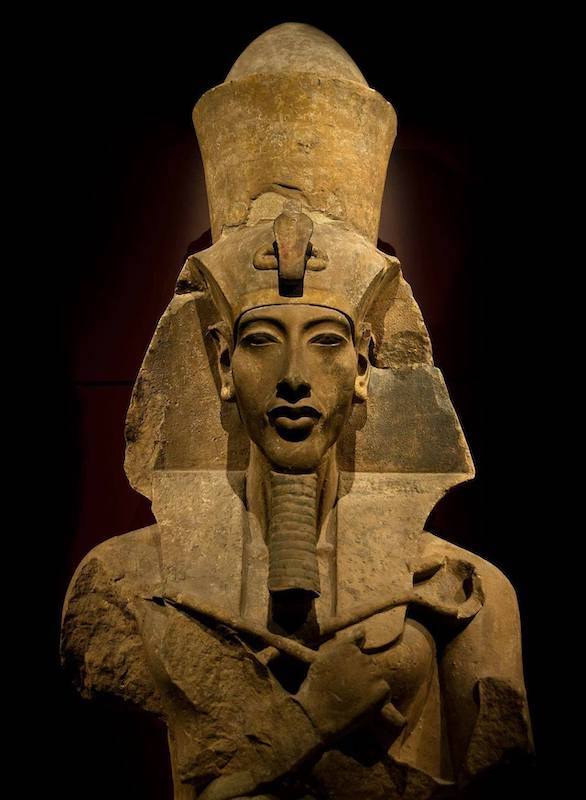 Akhenaton. FACEBOOK Egypt Cradle of civilization
Some historians like to compare Akhenaten to some of our modern belief systems like Islam and Catholicism. Akhenaten is often argued to be the kick-starter of monotheism, which is a type of faith that centers around one specified god instead of many (polytheism). The Bible, for example, says, “thou shalt not make unto thee any graven image,” mirroring how Akhenaten destroyed all kinds of art that suggested there may be more than one god.
His new religion may feel distastefully restrictive, but Akhenaten also ironically laid the foundation for an artistic revolution. Before his rule, Egyptian art was quite limited—scared to break tradition, artisans stuck to predetermined codes, patterns, and subject matter. Artists could even sculpt on top of an existing sculpture to represent a different person. Most unusually, art in Akhenaten’s time portrayed the queen and the royal children as readily as they did the king. Akhenaten made sure he and his family were drawn in the sizes of real-life proportions—instead of rendering the women and children tiny as did previous art—and Queen Nefertiti actually appeared on Akhenaten’s limestone walls twice as much as Akhenaten himself. Some depictions were rather scandalous by the standards at the time; art and sex went hand in hand. Meanwhile, other art illustrated scenes from the everyday life of the royal family—eating together, relaxing—that reflected their humanity as opposed to their divinity.
All of this suggest a strict loyalty to realism. In fact, the most stunning features of sculptures that depict Akhenaten are its androgynous, unmanly full lips and elongated necks. Combined with the skinny shoulders and waists, some scholars predict that Akhenaten had the Marfan syndrome, which is known to lead to such physical characteristics. If this truly was the case, Akhenaten’s art would have been a far cry from most portraits of important people you see: its loveliness came from its naturalism rather than its idealistic glory.
In fact, British Egyptologist Sir Matthew Petrie calls Akhenaten’s religion a “scientific theism,” blending modern scientific concepts with the world of the divine. To see the sun as a force which carries its energy through its rays, for example, is a clean break from the tradition in which every natural phenomenon was depicted through an anthropomorphic “god.”
In people’s minds, Akhenaten has been everything from “a proto-Christian, a peace-loving environmentalist, an out-and-proud homosexual, and a totalitarian dictator.” Appearing on one extreme in Nazi propaganda and on the other, as an icon of the Afrocentrist movement, Akhenaten is a man of many faces. On one hand he worshipped one god, making him a monotheist, but on the other, his “religion” consisted little of the anthropomorphic, dogmatic stories that the word usually entails. He was a power-hungry tyrant, but also a go-getting leader, breaking all sorts of economic and cultural limits on the way.
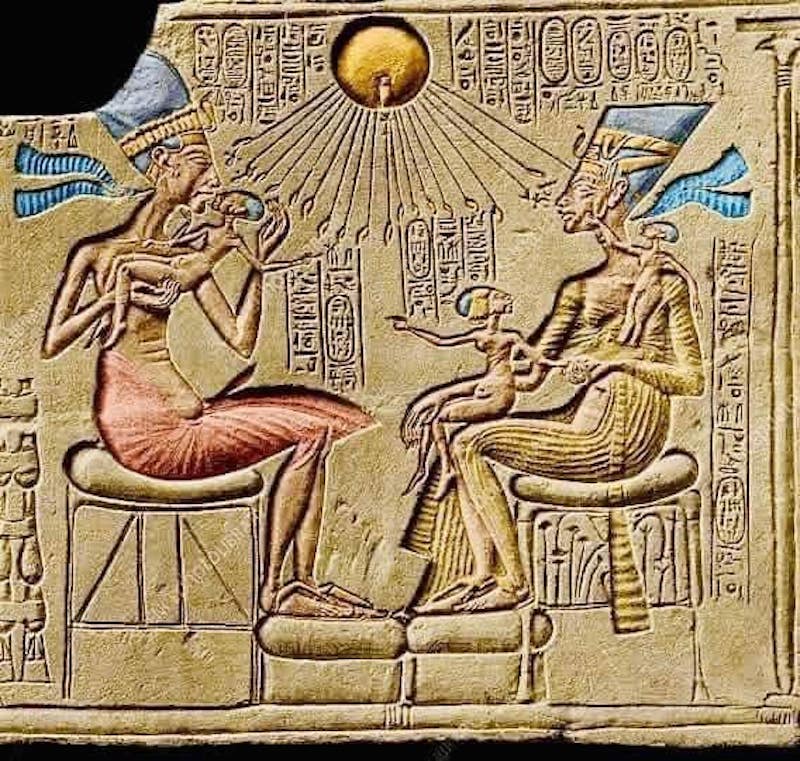 The inscriptions that Akhenaten left for his wife Nefertiti on the walls of the Amarna temples. FACEBOOK Ancient Explorers
History, after so much time has passed, is a little like playing a game of telephone like you did in your childhood, but in many directions and many groups of people at once. In one direction, you whisper a story to the person next to you and they whisper what they heard to the next person, and so on, until it reaches the last listener. You do the same in another direction, where another person hears and interprets the story in their own way…Soon, you have different people telling different versions of the same story. One of them may be “historically accurate,” but another one might be just as fascinating, if not more so. After all, reality doesn’t promise as much as does fantasy.
Archeologists at the site of Amarna, the capital city which Akhenaten himself founded, have discovered hundreds of buried bodies to have been malnourished and overworked. 92 percent of the bodies they found were not more than 25 years old before they died. Family were not found together; “in many cases it looks as if two or three unrelated people were tossed together into a grave.”
After Akhenaten’s death, much of Amarna was destroyed, not to be discovered again until just 1887 by Napoleon. This is why excavation in Amarna has a “forensic quality,” Peter Hessler writes for the National Geographic. It continues to be a challenge for historians to separate accuracy from wishful thinking. Hacking away at the many stories layered atop his biography, little romantic would be left.