Author Milan Kundera’s baffling response to a politically charged 20th-Century Czechoslovakia.
“There is no perfection only life.” — Milan Kundera
In the novel The Unbearable Lightness of Being (1984,) Czech author Milan Kundera establishes a fundamental oxymoron of life: that “weight” is cruel yet bearable, while “lightness” is unbearable. The first chapter introduces Nietzsche’s idea that, since life only happens once, and everything in life subsequently only happens once, it is impossible for us to predict the outcomes of different paths and choose the one that promises the best one. We can only go with the flow and pretend that we know what we’re doing. This lightness — of choice, of meaninglessness — torments the main characters in the novel.
Kundera had much of his life thrown around by political violence, and his presence in politics had been that much ambiguous. Having spent his adolescence through the Nazi occupation of Czechoslovakia, he later participated in the country’s liberation from the Soviet Union and contributed as a member in the Communist Party. At one point, the Czech authorities claimed that Kundera was behind the arrest of a Western spy (the truth of which we know nothing,) but he was also thrown out of the Communist Party for questionable political allegiances. He would re-enter the Party six years later. His actions are contradictory across partisan lines and ideologies. This confusion precisely represents his mission as an author: in his words, “the novelist teaches the reader to comprehend the world as a question.”
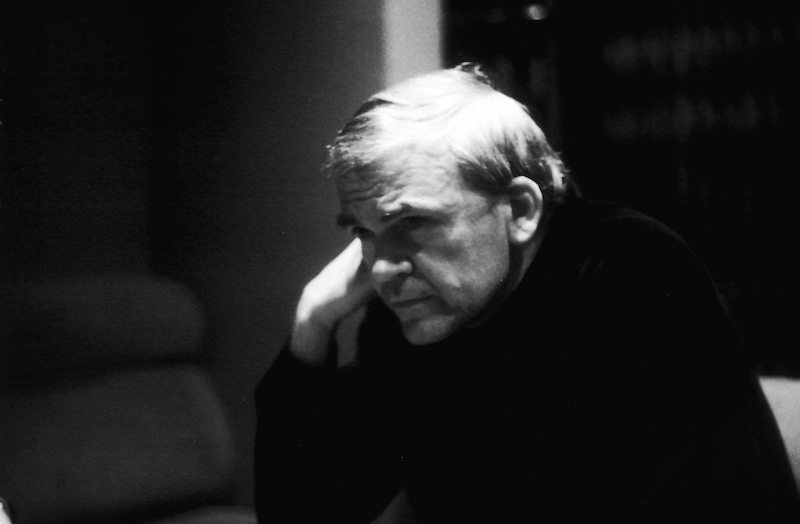 Milan Kundera. Source: The Paris Review
In The Unbearable Lightness of Being, one of his most famous works, Kundera’s central question tiptoes on the spectrum between “lightness” and “heaviness.” Tomas, the surgeon, is unable to resist his desire to flit from one mistress to another, all the while being in a committed, “heavy” relationship with his wife, Tereza. In fact, Tereza is the embodiment of “heaviness”: not only does she cling onto Tomas despite his infidelity like a lost puppy, she adopts a puppy herself. Joseph Mai, on the Johns Hopkins University Press, explains Tereza’s relation to her puppy as a shared suffering. The dog, which encumbers Tereza with the “heaviness” of care that it requires, is what keeps Tereza alive, as she cannot conceive of a life that lacks any responsibility for another being.
Both Tomas and Tereza die in a car crash. A car crash is possibly the most ironic of all forms of death. It comes indiscriminately, whether you are an unfaithful surgeon husband or an animal-loving, faithful wife. It comes to those who “deserve” it and those who don’t. There is no way to prepare for a car crash, no room for goodbye or “I love you.” One’s entire life, and all the heaviness that one has stacked atop it to assure its strength and meaning, dissolves with death. Ultimately, in Kundera’s view, death subjects all life into meaninglessness or, rather, dispels the illusion that it was ever meaningful to begin with.
 The Unbearable Lightness of Being. Source: Amazon UK
Throughout his works, Kundera is obsessed with the notion of playing with boundaries. These boundaries are what separates seriousness from the ridiculous.
“Man lives in close proximity to this boundary, and can easily find himself on the other side,” says Kundera in an interview.
Tomas, when operating on a patient, experiences a “brief but intense feeling of blasphemy.” The human body sheds its sacredness once it is breached by the scalpel, as it transcends the boundary of beauty and reveals its rawest, animal form. Similarly, a central image that irresistibly appears across Kundera’s novels is sex, his strongest example of how humans commit small acts of boundary-crossing all the time. Sex can be experienced as a sacred, beautiful activity, yet with one wrong step or intention, transcends the limits of sacredness and falls into fetishization and violence. The characters abundantly partake in both types of sex — the “heavy” and the “light.” If anything, Kundera thinks it impossible to stay on one side of the boundary at all. Humanity is condemned to confuse herself by eternally flipping between the two sides of the coin.
Ultimately, the choice between heaviness and lightness is ours. We can argue that Kundera himself lived a “heavy” life, writing and thinking about philosophical questions or actively participating in politics for the future of Czechoslovakia. But reading his books, we are astonished by their utter playfulness and harmless irony. Kundera neither condemns nor praises humanity; he mocks it. He places his readers and he himself firmly as his subject matter, and with Tomas and Tereza’s car crash, renders the very philosophies we choose to live by meaningless.