The history and science behind this unique self-care treatment.
Emerging from the Quadirikiri Cave at Arikok National Park in Aruba, my friends and I were heading for our car when one of the workers called out to us. “Don’t go. Go to Garra rufa,” he yelled. “Garra rufa.”
Seeing our faces scrunch with puzzlement, the worker walked over and further explained that just down the hill from the caves was a spring of Garra rufa, fish that ate the dead skin off hands and feet. The same little guys used for “fish pedicures” in spas across the globe.
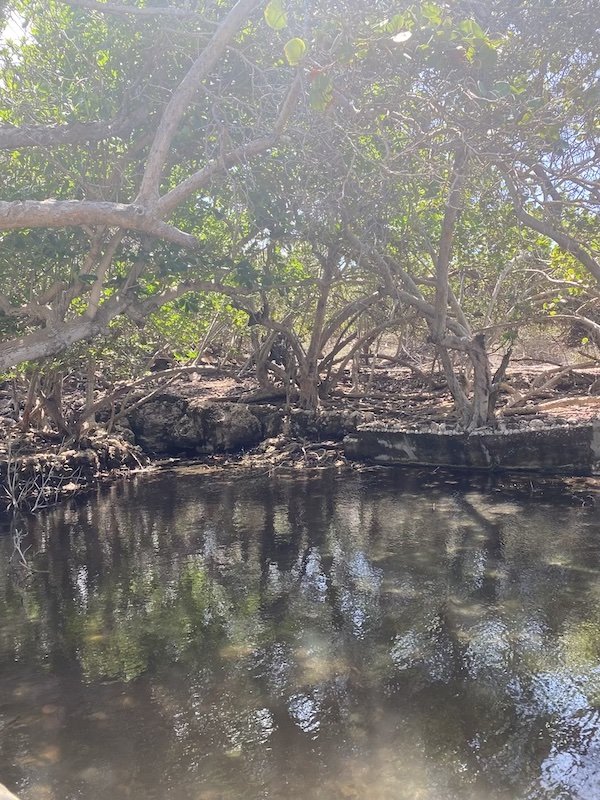 PHOTO GEORGE HASHEMI
The popular spa treatment originated in Kangal Fish Spring in Turkey; a spring located in Kangal. Local history suggests the practice was discovered in the early 1900s by a shepherd who healed his damaged feet in the spring water. As knowledge of the shepherd spread, popularity of Garra rufa traveled from Turkey to Asia and European regions. Fish pedicures found its way to the U.S. in 2008, with two services opening in Alexandria, Virginia, and Milwaukee, Wisconsin.
Formally known as Ichthyotherapy, a fish pedicure is a form of biotherapy where Garra rufa or “doctor fish” use their mouths to exfoliate and potentially heal skin. The treatment has been said to cure illnesses like psoriasis and eczema, though it is not medically proven.
I’d never experienced a fish pedicure myself, but I vaguely remembered seeing advertisements for them in the Puerto Vallarta airport spa. I’d heard that the tiny fish eat dead skin, leaving one’s skin feeling baby smooth, though the idea still felt somewhat uncanny.
Of course, curiosity led us to the water, and there they were – dozens of small, dark fish swimming in the narrow stream. Garra rufa is native to the Middle East, mainly inhabiting the water systems of Tukey, Iran, Iraq, and The Levant, the Eastern Mediterranean region of Western Asia. The fish occupy rivers, ponds, canals, and reservoirs, avoiding stagnant water. So, how did they end up here, halfway across the world, in the national park of Aruba? The answer is still a mystery, but here they were, swimming in the water before me.
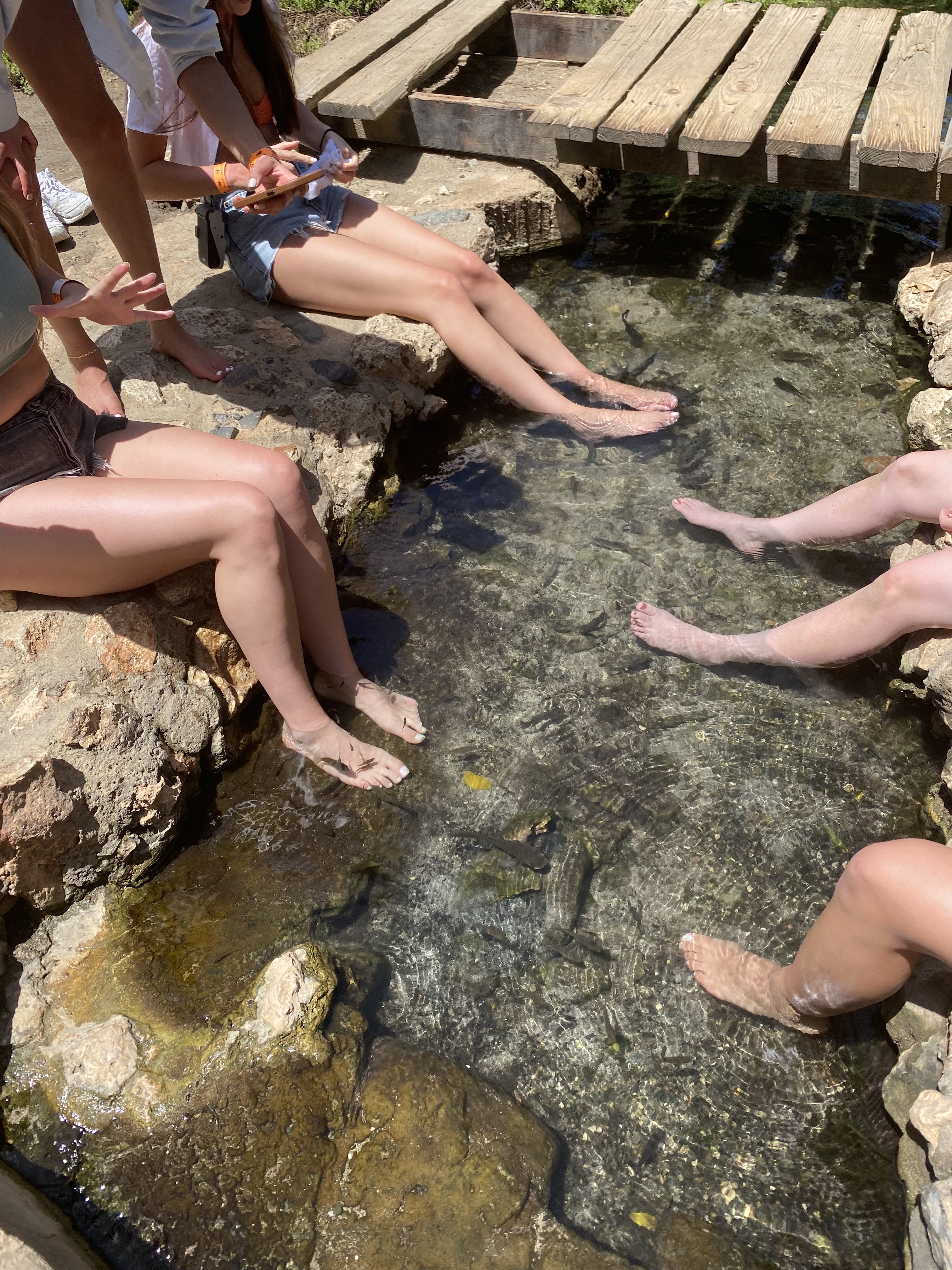 PHOTO GEORGE HASHEMI
Two middle-aged couples lounged along the water’s edge, pants rolled up, feet submerged. Watching the writhing clusters of fish surround their feet, fear began to creep in, but I gathered it wasn’t painful from their amused faces.
Soon after, I found my own legs dangling over the stream, feet hovering just above the water. I’ll be honest. I was hesitating and slightly scared. I knew it wouldn’t hurt. Garra rufa have no teeth, so they cannot bite someone. Yet, I felt like I was going against my most primal instincts to let fish, however small, attack my feet.
With one deep breath, and then another, I plunged my feet in. The water was cool and refreshing, and within seconds the Garra rufa were at my heels and toes. Had they felt the change in current, scented human skin or just saw my feet submerge, I wasn’t sure.
The feeling was more unfamiliar than uncomfortable, like mini suction cups trailing along my skin, nibbling at the dead skin. I could feel fish’s varying sizes, some sucking in much larger areas than others. It was vaguely ticklish. What was at first five fish became ten, then fifteen. I couldn’t help but feel slightly embarrassed at their adamant attention. Did it say something about my foot hygiene?
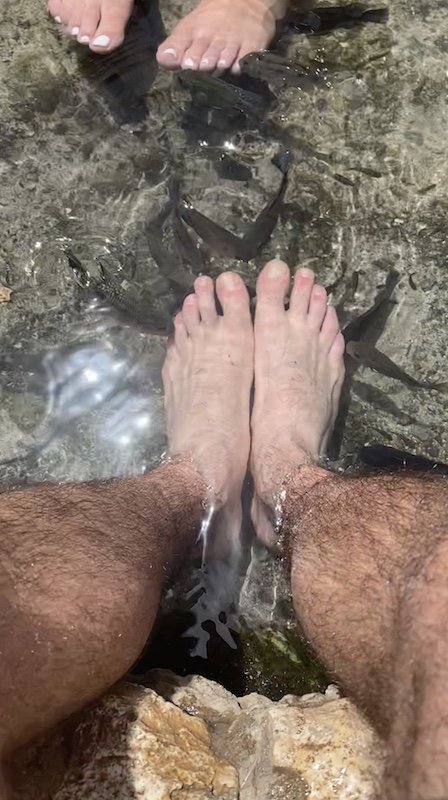 PHOTO GEORGE HASHEMI
On the topic of cleanliness, fish pedicures have been debated regarding how hygienic the practice is. Due to the fish’s considerable cost, salon owners are likely to use the same batch of fish multiple times; however, Garra rufa cannot be sanitized between customers, which runs the risk of spreading infection. Some U.S. states have banned the treatment entirely. Also, Garra rufa must be starved to eat dead skin, as they naturally eat algae, zooplankton, and organic matter.
So, some consider the usage of these fish in a spa treatment capacity as animal cruelty.
After what felt like a decade passed, I’d reached my limit and brought my feet from the nibbling swath. I would say the experience was an acquired pleasure. While I lasted only a few minutes, some of my friends left their feet in for over ten. It all comes down to personal preference. While I’m not sure I’d pay for this treatment at a spa, I’m glad to have experienced it in some capacity in Aruba. After all, I am a firm believer in trying everything once.