
The whole exhibit is meant as a storytelling tradition, which is something that is at the very heart of Catholicism.
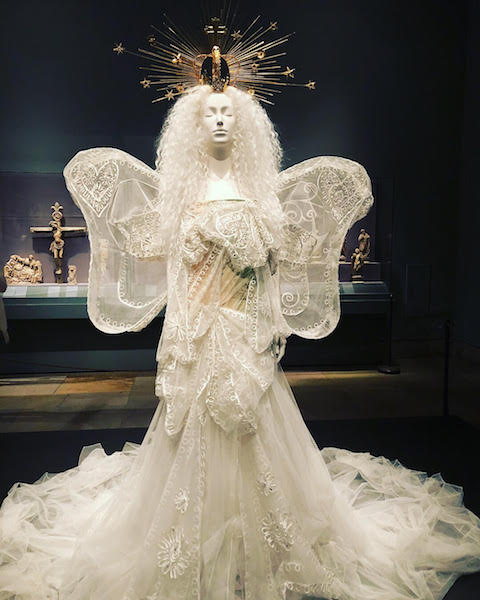 Heavenly Bodies Angel. PHOTO MACKENZIE DIAMOND
The Met Gala. One of fashion’s biggest nights, and Rihanna’s reminder to the world that she is a queen. This year the theme was “Heavenly Bodies: Fashion and the Catholic Imagination” and many of the stars delivered with their looks. However, the theme happened to stir up some major controversy, with some people calling it disrespectful to their religion and even going as far as to call it sacrilege. As a Catholic myself, I was a bit taken aback at first by some of the looks, and almost agreed with what some of the people were saying. However, after doing some research and realizing that the Vatican gave its stamp of approval, and even loaned out some artifacts for the exhibit, I was more open to it. I became curious about how Catholicism has influenced fashion over the years, and wanted to check out the exhibit before giving my final stamp of approval, thus I journeyed into New York City to check out the official exhibit at the Metropolitan Museum of Art.
The official website blurb states the following about the exhibit.
“The Costume Institute’s spring 2018 exhibition—at The Met Fifth Avenue and The Met Cloisters—features a dialogue between fashion and medieval art from The Met collection to examine fashion’s ongoing engagement with the devotional practices and traditions of Catholicism. Serving as the cornerstone of the exhibition, papal robes and accessories from the Sistine Chapel sacristy, many of which have never been seen outside The Vatican, are on view in the Anna Wintour Costume Center. Fashions from the early twentieth century to the present are shown in the Byzantine and medieval galleries, part of the Robert Lehman Wing, and at The Met Cloisters.”
 PHOTO MACKENZIE DIAMOND
In order to get the most out of the exhibit, I was determined to check out both The Met Fifth Avenue and The Met Cloisters, but you definitely don’t have to to get the full effect of the exhibit. The ticket you get includes entrance to both areas, and is valid for three days so it’s also possible to make a weekend out of it and do one area each day.
I started off at the Met Fifth Ave, and right off the bat I was entranced. I’ve never been super interested in high-end fashion, though I could fangirl over red carpet looks like the best of us, so it was an interesting experience for me. When you first walk in, there are two hallways to your right and left, and stairs going upstairs. (The exhibit is all on the first floor so don’t bother going upstairs just yet). In each hallway, there were sets of 5 mannequins on raised platforms wearing spectacular dresses that glimmered in the light. Even though they weren’t at eye level you could tell how detailed each dress was, and me liking all things sparkly, it was a great start to an exhibit. In little alcoves throughout the museum there were also smaller pieces, like bodices and jackets that we’re truly mesmerizing. The main part of the exhibit was in the medieval art room, a towering room which evokes a church interior. While the pieces themselves are gorgeous, the setting really made the exhibit. Playing in the background was a somber song, somewhat like a Gregorian chant, which gave the vibe an added boost.
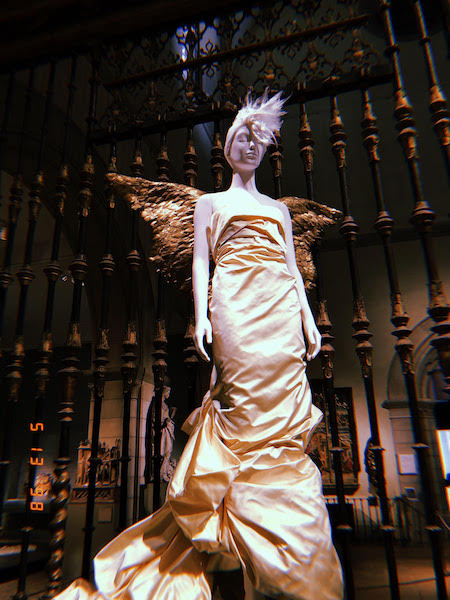 Heavenly Bodies Medieval Room. PHOTO MACKENZIE DIAMOND
I then traveled up to the Met Cloisters, a beautiful, old building surrounded by a lush park. Like the Met Fifth Ave, the venue really made the exhibit. Even though the Cloisters has never been a true monastery, you still get the religious vibe which really adds a lot to the fashion pieces. Many of them are positioned as if they were partaking in a religious act, whether it’s praying, getting married, or even going to God through death, so the added backdrop of, say the chapel, enhanced the experience. Outside of fashion, it was really cool to see artifacts from the Vatican that most people don’t get to see, such as vestments worn by Pope John Paul II.
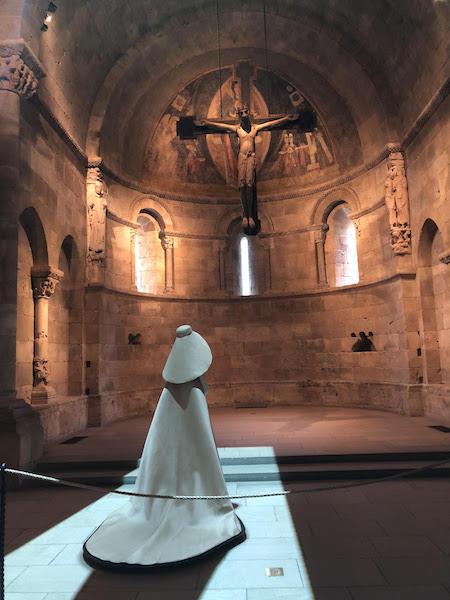 Heavenly Bodies Cloisters. PHOTO MACKENZIE DIAMOND
Overall, the fashion pieces we’re absolutely breathtaking and they gave me a new appreciation for fashion and for the influence Catholicism has on it. My whole viewpoint on the situation changed after being educated on the links between the church’s imagery and fashion’s creativity. Many of the designers themselves are Catholic, so it’s more about them expressing how their religion has influenced them and their work, as opposed to just thinking the imagery is “cool.” While there will be Catholics who criticize this as something that trivializes their faith, or is considered cultural appropriation, it is the opposite of their intention. The whole exhibit is meant as a storytelling tradition, which is something that is at the very heart of Catholicism. Look at artists like Michelangelo and Da Vinci. They produced exquisite art centered around religion, yet no one has ever thought that those works are negative, or a flashy show of disrespect. If one looks at fashion as art, which at its root it is, what the designers have done is exactly what Michelangelo or Da Vinci did, just with a different medium. I don’t believe that you can truly call either the Met Gala or this exhibit sacrilegious if you look at it from this perspective.
