The trek from the subway depths to Kyoto’s Museum of Modern Art is a strange one.
You pass streets clogged with uniformed school children, shops filled with teapots and scrolls, and a giant, crimson torii gate. And it isn’t a trek at the end of which you would expect to find a Japanese take on Gauguin. It is a gorgeous painting of yellow-skinned—not tanned—women in kimono, bathing by a stream, making a show of wringing their wet, shiny black hair. But where Gauguin’s paintings of Tahitian natives are flat like cloisonné enamel, this painting is flat like silken kimono prints, each leaf and wave sharply cut by thick paint.
But unlike the Tokyo Museum of Modern Art, Kyoto’s collection doesn’t just exhibit a Japanese version of “Western” art movements, or in the case of the bathing women, a reclaiming of Asian art techniques. The collection focuses more on the work of individual artists, such as Takahashi Yuichi and Shoichi Ida, whether or not they contributed to classified movements.
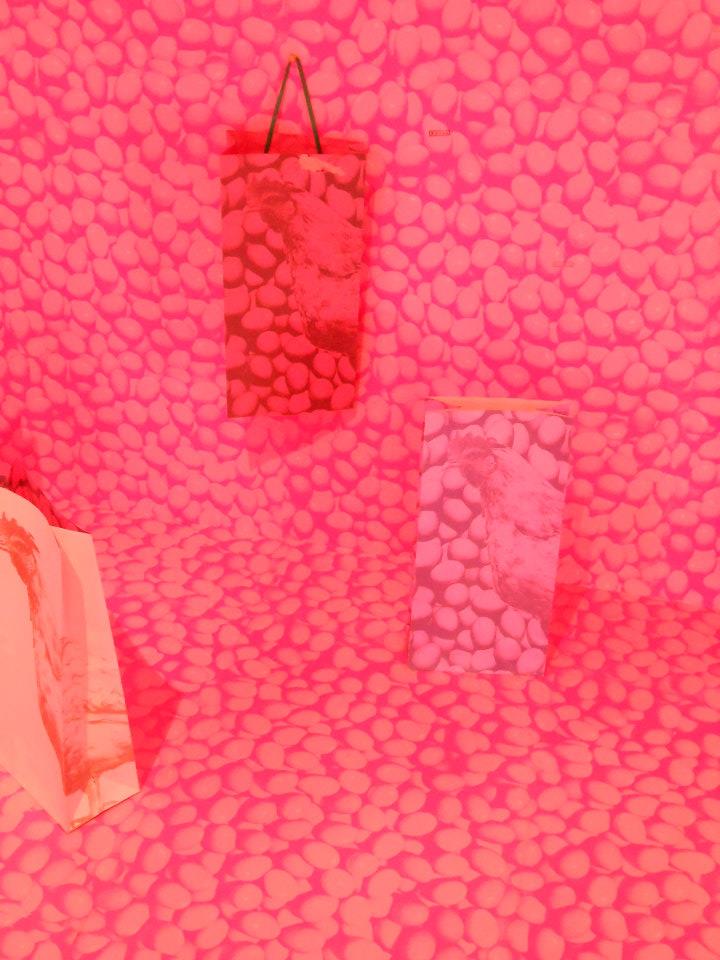
There is a room of Shoichi Ida’s “Conception” (1974)—hot pink and blanketed in egg-printed wrappings, that seeks to portray the warmth of the womb. A small TV plays loops and loops of video: a chick hatching from its egg. There you will be hypnotized until absorbed. The room is littered with paraphernalia related to egg-bearing culture, and any pictures taken inside are heavily pixilated due to the warm lighting. To wander in that heated room is to be diffused amongst the nutriment of the womb. Everyone appears to be underwater, oscillating between form and formlessness.
I doubt you could find these nuances associated with the womb in art anywhere else—confinement, ready nutriment, repetition, absorption. Here, Shoichi’s art alters the delicate fabric of that distant memory, supplanting whatever former beliefs you held regarding your gestation in that pink warmth. To reconquer such a fundamental memory captures the true power of art.