
The dubious relationship I’ve fostered with my American identity.
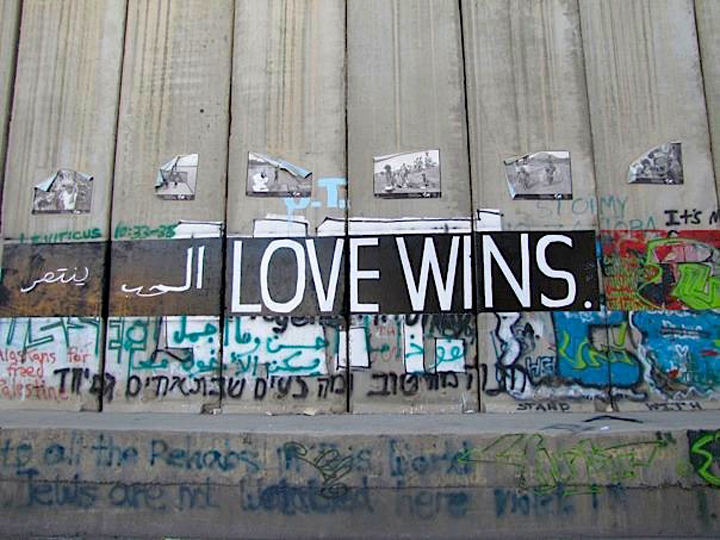 Graffiti on the wall that separates Jerusalem from Bethlehem: Love Wins. PHOTO MACEAGON VOYCE
My first article for Jetset Times addressed the advantages and shortfalls of linguistic disparities between cultures. Throughout that writing process, my initial stream-of-consciousness spout of prose repeatedly digressed from language and stumbled into the murky waters of cultural identity abroad. It didn’t take me long to realize that I was noodling with an issue deserving of its own focal point, and language seems like a good springboard from which to leap into that topic: the dubious relationship I’ve fostered with my American identity.
My girlfriend and I spent some time in Greece a year ago, traveling through Thessaloniki to Athens and then to Patras—from which we intended to sail across the Ionian Sea and continue our adventures in Italy. After waiting four days for a ferry strike to end (unsuccessfully) in Patras, we decided to take the long way around and thus found ourselves on a bus traveling from Thessaloniki to Bulgaria. I was, aside from my girlfriend, the only English-speaker on the bus. As I stated in my article on language barriers, it is initially unnerving to believe oneself to be choked off from communication, but the amount of dialogue that can be exchanged without a shared language is rather astounding. A greeting in any language is quite apparent—simply respond in kind. When offered tea on a bus, a nod and gracious smile get the point across. When an amused steward stops at your chair, holds up a map and shrugs, it’s not difficult to understand what he’s asking. “America,” I replied, and half the bus, observing our “conversation” from their seats, smiled and nodded knowingly, remarking amongst themselves. They had heard a word that transcends any linguistic divides, a powerful epithet for a concept that connotes so many different things to so many different people. Many on that bus undoubtedly revered America as a cultural and political cornerstone of the world; others did not share that sentiment.
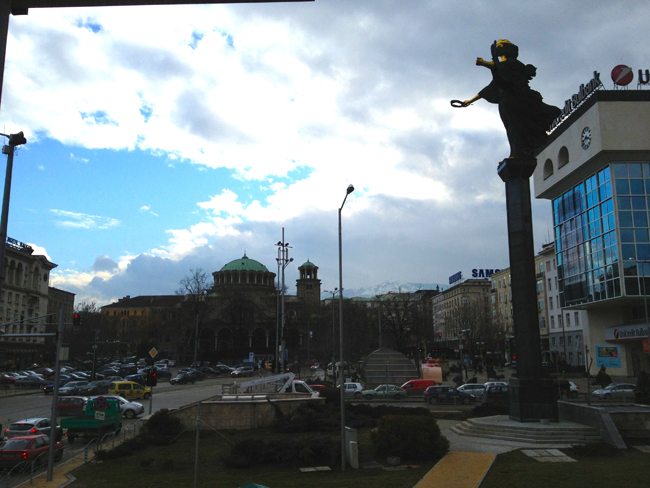 An image of the heart of Sofia, Bulgaria once we finally did make our next move. PHOTO MACEAGON VOYCE
We disembarked from our bus in Sofia, Bulgaria, gathered our luggage and began to think about our next move. My deliberation was interrupted by the hostile spatter of spit landing on my skin. Startled, I looked about and met the eyes of a nearby twenty-something man that had shared our bus and found in them a caustic loathing directed at me. I was at first confused, but it took only moments of cursory reflection to realize his outburst must have been derived from the only word I had spoken on the bus that anyone had understood. It would be relatively fruitless to speculate about his grounds for disdain, especially because I could not even ask him. Perhaps his hate stemmed from the meritless privilege I have been afforded by being an American, or from America’s history of unilateral transgressions and forays into global policing. It is moments like these when I wish I did possess a shared language, because no amount of social grace would quell his hatred, or his convictions that I represent an evil, entitled country. America is part of my identity, and that is never more evident than when I am abroad. While I feel both pride and shame in my nationality, it is my responsibility to be an informal ambassador, to show people that I am more than America, and that Americans can be more than a political entity.
The Fourth of July is fast approaching, and of course it is a day of great importance for our country. America’s independence day represents both a moment that catalyzed a people’s declaration of liberty and justice for all and an enduring desire for freedom. It is that innate sense of equitability that has caused us to perhaps exceed the jurisdiction of our borders, and it has subsequently created a sense of responsibility for all peoples of the world. There is certainly good in that, in theory. However, political agendas and power frenzies muddle that ostensibly altruistic approach—questions of ulterior motives arise, and America is often blamed for sticking its democratizing hands into places it should not. Injustice runs rampant in this world and a desire to rid it of such transgressions is admirable, but it is important to be pragmatic in what one country can achieve in the pursuit of that objective. And it is outrageous to believe we can truly purge the world of injustice when our political interventions hypocritically abide by an explicitly hierarchical projection of peoples. This prejudice can be substantiated by many examples, but I will write of one with which I have experienced firsthand: our unwavering alliance with Israel.
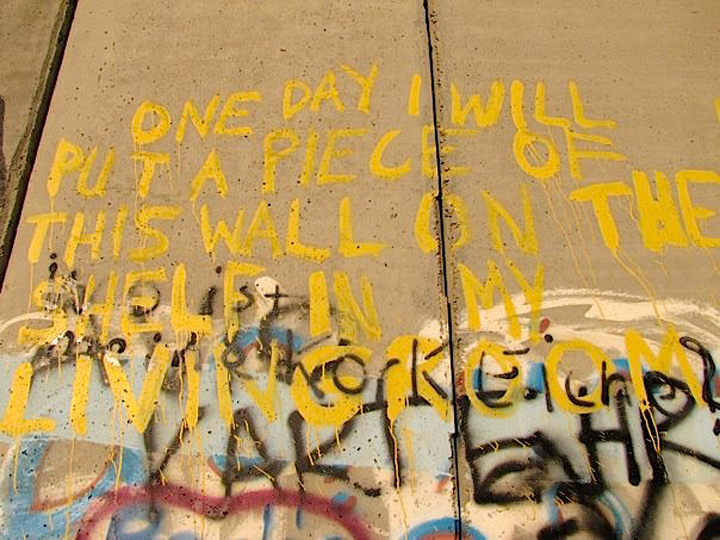 Graffiti on the wall that separates Jerusalem from Bethlehem: ‘One day I will put a piece of this wall on the shelf in my living room. PHOTO MACEAGON VOYCE
I spent July 4th in Israel and Palestine two years ago and I was shocked by the oppression I witnessed. One day I boarded a bus to travel from Bethlehem to Jerusalem (which meant (technically) crossing from the West Bank into Israel) and I was amongst a dozen or so passengers—most of whom were Palestinian. Upon reaching the checkpoint, the Palestinian people were corralled by Israeli soldiers with guns the size of toddlers, and then forced to stand outside in a line to have their papers checked, while I, an American, was spared any such discomfort. In a foreign land, I had more rights than even those native to it, and that was sickening. Zealotry—both political and religious—spurs the disconnect between these two peoples, and America’s unwillingness to recognize the Palestinian cause reaffirms Israel’s oppressive practices and evinces the aforementioned hierarchy of cultural worth.
I acknowledge the fact that the issues of America’s impotence, Israel’s persecution and even Palestine’s victimization are not black and white. There are certainly Americans that do everything in their power to advance the Palestinian cause, and Israelis that oppose the injustice, and Palestinians that handle the strife to deleterious results. But, the fact is Israel continues to build settlements on Palestinian territory and the oppressive status quo remains. There is no doubt of the injustice, and America’s reluctance to both confront Netanyahu’s illegal settlement building and upgrade Palestine’s UN status to that of member state once again suggests that the US perceives the two cultures inequitably; thus, we fail to uphold our declaration written back in 1776, that all men are indeed created equal. It is a decree in which—aside from the then-customary patriarchal phrasing—there should be no room for interpretation; yet somehow people find it.
The point is, if the goal is to fight injustice, then fight injustice. Measure it in the words of Martin Luther King Jr., “Justice is love correcting that which revolts against love.” Most of us are encumbered by our lack of proximity to blatant subjugation (though it is often closer than it seems), and we cannot truly appreciate justice without first experiencing the unjust. As is the case with many things, the best way to do that is to immerse yourself in it. Travel to Palestine, travel to Uganda, travel to Russia, look closer into the institutional inequities of our own country. Be curious, be adventurous, acquire empathy and bring it home with you. Become aware of the fact that we are first and foremost human; there is perhaps no greater realization than this.
Article written by MACEAGON VOYCE.
